Showing posts with label steelhead. Show all posts

Friday, January 13, 2012

Elwha River Weir Summary 2011


The Elwha River weir (a temporary trap) was re-installed on August 18, 2011, to count and collect biological data from adult salmon and steelhead as part of an ongoing effort to determine how these populations change as a result of dam removal. A secondary goal is to provide broodstock for hatchery production and conservation during dam removal when turbidity levels are expected to be lethal to fish in the river.

2.340 cfs and still working
Due to an unusually high snowpack (190% of normal), the trap had to be installed at a flow of 1,640 cubic feet per second (cfs). The first fish caught was a sockeye, which was marked and passed upstream. The trap fished continuously from August 18 to October 19, 2011, except for three days when flows exceeded 4,000 cfs. The weir was once again pushed to the limits in 2011, fishing at flows over 2,500 cfs (compared to a high of 2,200 cfs in 2010), which significantly exceeded our weir design expectation of 2,000 cfs. The weir was removed on October 19, 2011, after the removal of a log boom at the Elwha Dam which resulted in the release of hundreds of large logs into the lower Elwha River.

A total of 647 live and dead (carcasses) salmon and trout were captured at the weir during the 2011 summer/fall season, compared to 492 fish captured in 2010. A total of 218 live adult salmon and trout, representing seven different species including Chinook (73), pink (129), chum (1), coho (1), and sockeye salmon (8), and steelhead (3) and bull trout (3) were captured at the weir in 2011.  

Species present in the Elwha River
Fifty-five Chinook salmon were retained for the Washington Department of Fish and Wildlife Chinook salmon broodstock program at the Elwha rearing channel. One hundred twelve pink salmon were also retained as broodstock for the pink salmon captive brood program. This program is designed to protect the pink salmon stock during lethal turbidity levels occurring during dam removal.

In addition to the live fish caught at the weir, 429 salmon carcasses, including 381 Chinook and 48 pinks, were handled. These post-spawn carcasses represent fish that had either migrated upstream past the weir before it was installed or were passed above the weir by weir personnel.

Data collected for fish caught at the weir included, species, fish condition, sex, origin (wild/hatchery), presence/absence of coded-wire tags and passive integrated transponder tags (PIT), fin condition, length, scale samples for aging, DNA samples, and information on adult run timing. Otolith samples were collected from Chinook salmon carcasses.

Sampling a sockeye salmon for PIT tag detection
The weir is planned to be re-installed during the winter of 2012 to capture and count adult steelhead and any other adult salmonids migrating in the Elwha River. In addition to biological data collection, the weir will be used in conjunction with a SONAR system to assess steelhead abundance.


The Elwha River weir project is part of a multi-agency effort which includes the Lower Elwha Klallam Tribe, National Oceanic and Atmospheric Administration (NOAA), Olympic National Park, U.S. Fish and Wildlife Service, U.S. Geological Survey, and Washington Department of Fish and Wildlife (WDFW), to evaluate the response of adult salmonids to the removal of two Elwha River hydroelectric dams. The weir was funded in 2011 by cooperating agencies as part of their annual budget. Additional funds were obtained through the President’s stimulus program (American Recovery and Reinvestment Act) which funded the project through September 30, 2011. The weir is funded through September 30, 2012, with funds provided by USEPA through the Puget Sound Partnership.


Friday, December 23, 2011

2011 in Review: Elwha Dam Removal and the Fish Weir

As we reach the end of 2011, we find ourselves wondering how the year went by so quickly and thinking about some of the highlights. For our office, this year will definitely be remembered as the year that removal of two large dams on the Elwha River finally started. Since early September, much progress has been made in tearing down the dams. A time-lapse video of the dam demolition can be viewed at http://www.video-monitoring.com/construction/olympic/js.htm. For more information on the events leading up to demolition and how our office has been involved, visit http://www.fws.gov/wafwo/dams.html.

Elwha Dam on December 23, 2011
Once the dams have been completely removed, it won't be long before anadromous fish will once again have access to the >70 miles of pristine aquatic habitat located upstream in Olympic National Park. We intend to document how quickly these salmon, steelhead, and bull trout populations rebound by counting them on their journey up the river in coming years. In late 2010, we added a post describing the weir structure being operated by the Washington Department of Fish and Wildlife (in partnership with USGS, NOAA-Fisheries, Olympic National Park, the Lower Elwha Tribe, and our office). To date, this is our most frequently visited story since starting the blog.


Friday, June 10, 2011

Logjams for Salmon and Bull Trout in the Skokomish River

The Skokomish River is the largest source of fresh water for Hood Canal, a 70-mile natural fjord-like side basin of Puget Sound. It is also the most frequently flooded river in Washington State. The Skokomish River is home to four species of salmon and trout that are listed as threatened under the Endangered Species Act. After years of intense logging, road building and development in the watershed, strong partnerships have formed to turn the tide of worsening conditions and restore the river.

The U.S. Fish and Wildlife Service (FWS) provided funds to the Skokomish Tribe to complete one of the largest logjam projects in the Pacific Northwest. Through the support of many partners throughout Hood Canal, 30 massive man-made logjams were placed along 1 mile of the mainstem South Fork Skokomish River last summer. These structures were installed to stabilize streambanks, restore stream function, and improve aquatic habitat in a reach that had been cleared for a proposed reservoir in the 1950s. The goal of the project is to improve fish habitat by increasing pools and habitat complexity--large pools create microhabitats where fish can hide and stay cool. 


Logjam construction             (Photo: Skokomish Tribe)
 To create the logjams, over 2,000 second-growth trees were uprooted at upland sites and transported to the stream by helicopter. The trees averaged 100 feet long and were embedded far into the streambanks using excavators. Smaller trees and log sections were then carefully wedged in to create a very complex and dense logjam. Planting of trees along banks and within the floodplains has also begun and will continue in following years.

The structures were placed strategically in a section of the South Fork Skokomish that had few natural logjams. This area, approximately 11-14 miles upstream from where the Skokomish empties into Hood Canal, was heavily logged in the 1950's and 1960's in preparation for a dam that was never built. The lack of streamside structure allowed the river to subsequently grow wider and shallower, causing the water temperature to rise. The addition of these logjams should cause the water to carve out a deeper, more natural channel, result in cooler temperatures, and help retain spawning gravels for the fish to use. In addition, vegetation is likely to grow along the edges of the logjams, eventually shading the river and providing natural structure.

Fortunately, the logjams held up well to last winter’s storms and flooding. Few components of a small number of the jams were lost, while several of the structures even managed to collect additional logs that were floating downstream. As of April 2011, deep pools had already formed downstream of the logjams, creating places for fish to rest, find refuge, and feed. With these habitat improvements, the upper reaches of the Skokomish River should be able to support larger runs of threatened steelhead and bull trout. Additional benefits will accrue for federally-listed summer/fall and spring Chinook salmon, coho salmon, rainbow and cutthroat trout, and lampreys.

Before construction              (Photo: Skokomish Tribe)

After construction                (Photo: Skokomish Tribe)
The Skokomish Tribe sponsored this project. Partners included the U.S. Forest Service, TEAMS Enterprise, FWS, Hood Canal Coordinating Council, and the Skokomish Watershed Action Team. The Skokomish Tribe acquired $729,000 in Washington Salmon Recovery Funding Board and FWS grant funding for this project. The Forest Service contributed $525,000, which includes the value of the trees, planning and construction costs.

More logjams are needed downstream of the project area and construction will begin as soon as funding and approval is acquired.


Friday, April 29, 2011

Wild Salmon Production at the Northwest Corner of the United States

This year we began monitoring wild salmon and steelhead in the Tsoo-Yess River, located at the northwest tip of the Olympic Peninsula near Neah Bay, Washington.  The goal of the project is to determine how many wild salmon and steelhead juveniles are produced each year in the part of the Tsoo-Yess River upstream of Makah National Fish Hatchery (NFH).  Results from this study will tell us about the ability of the Tsoo-Yess River to support wild salmon and help the USFWS and Makah Tribe determine how to best manage Makah NFH operations while supporting wild fish populations. 

USFWS student intern Ben Leonard checks 
the screw trap for fish
This week we installed a screw trap just a few hundred meters upriver of the hatchery.  A screw trap (see picture) has a rotating cone that captures fish moving downstream.  Fish are held in a live box at the back of the trap where they wait to be removed, identified, and measured by a biologist.  Although it might look a little scary, these traps are actually very gentle on the fish.  On the first 2 days, we captured 18 coho salmon and 3 steelhead smolts, as well as a few coho fry, some juvenile cutthroat trout and rainbow trout/steelhead, 2 sculpins, and 1 lamprey.

Of course, these traps can’t catch every fish migrating downstream, so we have to test how efficient the trap is at catching fish.  To do this, we release marked fish a few hundred meters upriver to see what percentage we catch in the trap.  We put the marked fish in buckets (with aerators) and took them by canoe upriver to the release site (picture below).  Not a bad job on a sunny day!

Ben releases marked fish to check trap efficiency


Wednesday, November 10, 2010

Elwha River Weir

An adult fish trap, termed a resistance board weir, was installed in the Elwha River in September 2010 to begin counting adult salmon, trout, and char migrating upstream and downstream in the Elwha River. The weir is part of a multi-agency effort, which includes the Lower Elwha Klallam Tribe, National Oceanic and Atmospheric Administration (NOAA), Olympic National Park, U.S. Fish and Wildlife Service, U.S. Geological Survey, and Washington Department of Fish and Wildlife (WDFW), to monitor the influence of removing two Elwha River hydroelectric dams on salmon and steelhead returns to the Elwha River ecosystem. The goal of the project is to count migrating adult salmon and steelhead to determine if run sizes increase in the Elwha River following dam removal. A portion of the adult salmon captured at the weir will also be used as broodstock for hatchery production and conservation.  Hatcheries will be used for Chinook salmon, coho salmon, chum salmon, pink salmon, and steelhead as a safeguard to protect Elwha River salmon runs during dam removal, which is expected to result in short-term sediment concentrations that may kill adult salmon. In addition, information will be obtained from the weir to determine when different species of adult salmon enter the river, their age, and genetic makeup.

Adult trap (resistance board weir) in the Elwha River
At 195 feet across, the Elwha weir is thought to be the largest floating weir on the WestCcoast. The weir consists of 52 floating panels connected to a substrate rail. The substrate rail is comprised of 10-foot sections of 3-inch angle iron which are bolted together and secured to the streambed using rebar stakes. The floating panels block fish migration and direct the fish to one of four trap boxes; these boxes can be placed in different positions as needed. There are currently three upstream trap boxes---two on one side of the river and one on the opposite bank. There is also one downstream trap box. Now that the substrate rail is in place, the weir can be installed in approximately 2 days and removed in only a few hours.

The new Elwha weir fished for 30 days in 2010 and captured a total of 492 adult salmon and trout, representing eight different species, including Chinook, pink, chum, coho, and sockeye salmon, steelhead, cutthroat trout, and bull trout. Chinook salmon were captured in the greatest number---461 individuals. Pink salmon were the next most common species captured with 12 individuals.  Although the weir was pulled prior to the peak of the coho and chum salmon runs, both species were captured. In addition, summer-run and/or early returning winter-run steelhead were captured.  The capture of pink salmon surprised us, since pinks generally return to Puget Sound rivers only during odd years (2009, 2007, etc.). They have, however, become more common during even years over the last decade.
 
The weir fishing at 2,200 cfs
The weir is planned to fish a majority of the time during the summer and early fall, when Chinook and pink salmon are migrating into the Elwha River. However, it is expected to fish only part-time during late fall through spring when storms and/or snow melt result in high water in the river. The weir fished successfully during flows of 2,200 cubic feet per second (cfs) in late summer (500 cfs is the normal low flow during summer). This was encouraging, since the weir was predicted to be able to fish up to about 2,000 cfs. 

The weir is planned to be re-installed in early 2011 to direct adult steelhead to the river margins where they will be counted using SONAR. The trap boxes will be installed in late winter or early spring to trap adult steelhead. The weir will be removed again during the spring snow melt and then reinstalled with traps as flows begin to decrease in early summer.

This project was funded in part by funds provided to the cooperating agencies as part of their annual budget.  Additional funds were obtained through the President’s stimulus program (American Recovery and Reinvestment Act). The project is currently funded through September 30, 2012.

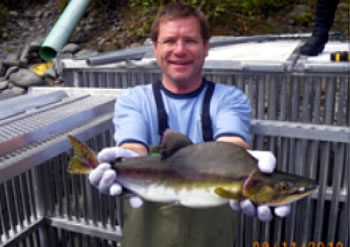
Here are some of the fish captured by the weir:

Chinook salmon
 
Coho salmon

Chum salmon

Pink salmon

Sockeye salmon

Bull trout

Cutthroat trout
 
Steelhead