Showing posts with label fish weir. Show all posts

Friday, June 22, 2012

USFWS Internship - Spring 2012 Field Work - Part 2

Zach Moore
More about my field work experiences . . . .

I also had a chance to help sample Olympic mudminnow around Olympia with Roger Tabor, USFWS biologist. This was a great way to get some new knowledge of, and experience with, a species of fish I previously knew nothing about. I went to several different wetlands to catch and sample these interesting little fish. The capture method involved swiping a frame net into murky ponds and pulling out handfuls of mudminnows. We sedated the fish so we could collect data such as length and weight, as well as stomach samples for diet analysis, and then returned them to the pond.

But my favorite field work opportunity was working on the Tsoo-Yess River on Washington's Olympic Peninsula near Makah National Fish Hatchery. I went up there with a crew for several days at a time. Our goal was to capture and collect outmigrating juvenile salmonids such as steelhead trout, coho salmon, and Chinook salmon. To do this, we installed a fish weir (river fence) that directed these small fish to the rotary screw trap. Installing a fish weir is a lot of work and it took us a couple of days to finish the entire thing, but when it was done it felt like a great accomplishment. I also assisted with the screw trap sampling where I gained experience utilizing a useful fish sampling device and improved my fish identification and data collection skills.

Sampling juvenile salmon at the screw trap on the Tsoo-Yess River
(fish weir in background)
I feel fortunate to have had this valuable opportunity with the USFWS. I was able to receive 16 college credits for my work and build and diversify my resume at thr same time. It was also a great way to get my foot in the door with the USFWS. My hard work paid off--I applied and successfully competed for a paid seasonal fisheries technician position with the USFWS Fisheries Division!

Working in the field was definitely my favorite part of my spring internship and I can’t wait to do more this summer! I am looking forward to new adventures and career-building experiences this coming summer. Stay tuned!


--Zach Moore, USFWS Intern/Fisheries Technician

Thursday, March 15, 2012

USFWS Internship & Mentoring Programs

Zach Moore
Greetings!  My name is Zach Moore and I am a fisheries and outreach intern with the U.S. Fish & Wildlife Service (USFWS) in Lacey, Washington. This internship is in conjunction with The Evergreen State College, where I am a sophomore focusing on environmental science & education. While my college coursework has been essential in preparing me for a career in my focus areas, the importance of resume-building professional experience cannot be overemphasized. The Evergreen State College provides its students with credit-earning opportunities for gaining this type of experience. For example, the “Citizen Science: Ecoliteracy” class that I am currently taking actually requires at least 80 hours of internship work. So when the USFWS posted an internship opportunity this past fall, I jumped on it.

This internship has already provided me with top-notch experience in both of my college focuses. For environmental education, I have had a lot of opportunities to work in classrooms with students, including visits to Onalaska High School, Reeves Middle School, Mill Creek Elementary, and a field trip with Timberland High School students to Tolmie State Park. During these events, I assisted with classroom presentations and fish dissections. It has been great interacting with these future natural resource stewards and their enthusiasm been nothing short of contagious.

Zach with weir panel
For the environmental science component, one highlight was assisting with the Elwha River weir project. A fish weir is a tool that is used to capture, count, and study fish populations. It is like a fence that spans across the river directing migrating salmon and steelhead into a trap box. We made two separate multi-day trips to Port Angeles to repair the weir panels and then install the weir in the river. It was great to be able to get in a dry suit, slap a snorkel on my face, and dive in the Elwha River to install the panels I had previously repaired. The visibility in the river was less than 6 inches during the days I was working and installing the panels which proved to be both challenging and rewarding. It was awesome to have the opportunity to assist with this historic project. Now that the dams are being removed, this fish weir will help document how the salmon and steelhead respond to having access to the upper Elwha River once again.

Zach and USFWS biologist installing weir panel
This rewarding experience has motivated me to pursue a full quarter-long internship with the USFWS this spring. Instead of averaging 10 hours a week like I did this past winter quarter, I will be working 30-40 hours a week and gaining far more experience. I will be leading my own classroom curriculum and gaining experience in a variety of field projects including electrofishing, screw trapping for outmigrating salmon, and Olympic mudminnow sampling . . . all of this while earning college credits! This sort of experience will really pay off when it’s time to compete for paid positions. 

For a video explaining the Elwha River weir project (including installation and sampling footage), visit:
http://www.youtube.com/watch?v=N7WuO8n5CQE


Friday, January 13, 2012

Elwha River Weir Summary 2011


The Elwha River weir (a temporary trap) was re-installed on August 18, 2011, to count and collect biological data from adult salmon and steelhead as part of an ongoing effort to determine how these populations change as a result of dam removal. A secondary goal is to provide broodstock for hatchery production and conservation during dam removal when turbidity levels are expected to be lethal to fish in the river.

2.340 cfs and still working
Due to an unusually high snowpack (190% of normal), the trap had to be installed at a flow of 1,640 cubic feet per second (cfs). The first fish caught was a sockeye, which was marked and passed upstream. The trap fished continuously from August 18 to October 19, 2011, except for three days when flows exceeded 4,000 cfs. The weir was once again pushed to the limits in 2011, fishing at flows over 2,500 cfs (compared to a high of 2,200 cfs in 2010), which significantly exceeded our weir design expectation of 2,000 cfs. The weir was removed on October 19, 2011, after the removal of a log boom at the Elwha Dam which resulted in the release of hundreds of large logs into the lower Elwha River.

A total of 647 live and dead (carcasses) salmon and trout were captured at the weir during the 2011 summer/fall season, compared to 492 fish captured in 2010. A total of 218 live adult salmon and trout, representing seven different species including Chinook (73), pink (129), chum (1), coho (1), and sockeye salmon (8), and steelhead (3) and bull trout (3) were captured at the weir in 2011.  

Species present in the Elwha River
Fifty-five Chinook salmon were retained for the Washington Department of Fish and Wildlife Chinook salmon broodstock program at the Elwha rearing channel. One hundred twelve pink salmon were also retained as broodstock for the pink salmon captive brood program. This program is designed to protect the pink salmon stock during lethal turbidity levels occurring during dam removal.

In addition to the live fish caught at the weir, 429 salmon carcasses, including 381 Chinook and 48 pinks, were handled. These post-spawn carcasses represent fish that had either migrated upstream past the weir before it was installed or were passed above the weir by weir personnel.

Data collected for fish caught at the weir included, species, fish condition, sex, origin (wild/hatchery), presence/absence of coded-wire tags and passive integrated transponder tags (PIT), fin condition, length, scale samples for aging, DNA samples, and information on adult run timing. Otolith samples were collected from Chinook salmon carcasses.

Sampling a sockeye salmon for PIT tag detection
The weir is planned to be re-installed during the winter of 2012 to capture and count adult steelhead and any other adult salmonids migrating in the Elwha River. In addition to biological data collection, the weir will be used in conjunction with a SONAR system to assess steelhead abundance.


The Elwha River weir project is part of a multi-agency effort which includes the Lower Elwha Klallam Tribe, National Oceanic and Atmospheric Administration (NOAA), Olympic National Park, U.S. Fish and Wildlife Service, U.S. Geological Survey, and Washington Department of Fish and Wildlife (WDFW), to evaluate the response of adult salmonids to the removal of two Elwha River hydroelectric dams. The weir was funded in 2011 by cooperating agencies as part of their annual budget. Additional funds were obtained through the President’s stimulus program (American Recovery and Reinvestment Act) which funded the project through September 30, 2011. The weir is funded through September 30, 2012, with funds provided by USEPA through the Puget Sound Partnership.


Friday, December 23, 2011

2011 in Review: Elwha Dam Removal and the Fish Weir

As we reach the end of 2011, we find ourselves wondering how the year went by so quickly and thinking about some of the highlights. For our office, this year will definitely be remembered as the year that removal of two large dams on the Elwha River finally started. Since early September, much progress has been made in tearing down the dams. A time-lapse video of the dam demolition can be viewed at http://www.video-monitoring.com/construction/olympic/js.htm. For more information on the events leading up to demolition and how our office has been involved, visit http://www.fws.gov/wafwo/dams.html.

Elwha Dam on December 23, 2011
Once the dams have been completely removed, it won't be long before anadromous fish will once again have access to the >70 miles of pristine aquatic habitat located upstream in Olympic National Park. We intend to document how quickly these salmon, steelhead, and bull trout populations rebound by counting them on their journey up the river in coming years. In late 2010, we added a post describing the weir structure being operated by the Washington Department of Fish and Wildlife (in partnership with USGS, NOAA-Fisheries, Olympic National Park, the Lower Elwha Tribe, and our office). To date, this is our most frequently visited story since starting the blog.


Wednesday, November 10, 2010

Elwha River Weir

An adult fish trap, termed a resistance board weir, was installed in the Elwha River in September 2010 to begin counting adult salmon, trout, and char migrating upstream and downstream in the Elwha River. The weir is part of a multi-agency effort, which includes the Lower Elwha Klallam Tribe, National Oceanic and Atmospheric Administration (NOAA), Olympic National Park, U.S. Fish and Wildlife Service, U.S. Geological Survey, and Washington Department of Fish and Wildlife (WDFW), to monitor the influence of removing two Elwha River hydroelectric dams on salmon and steelhead returns to the Elwha River ecosystem. The goal of the project is to count migrating adult salmon and steelhead to determine if run sizes increase in the Elwha River following dam removal. A portion of the adult salmon captured at the weir will also be used as broodstock for hatchery production and conservation.  Hatcheries will be used for Chinook salmon, coho salmon, chum salmon, pink salmon, and steelhead as a safeguard to protect Elwha River salmon runs during dam removal, which is expected to result in short-term sediment concentrations that may kill adult salmon. In addition, information will be obtained from the weir to determine when different species of adult salmon enter the river, their age, and genetic makeup.

Adult trap (resistance board weir) in the Elwha River
At 195 feet across, the Elwha weir is thought to be the largest floating weir on the WestCcoast. The weir consists of 52 floating panels connected to a substrate rail. The substrate rail is comprised of 10-foot sections of 3-inch angle iron which are bolted together and secured to the streambed using rebar stakes. The floating panels block fish migration and direct the fish to one of four trap boxes; these boxes can be placed in different positions as needed. There are currently three upstream trap boxes---two on one side of the river and one on the opposite bank. There is also one downstream trap box. Now that the substrate rail is in place, the weir can be installed in approximately 2 days and removed in only a few hours.

The new Elwha weir fished for 30 days in 2010 and captured a total of 492 adult salmon and trout, representing eight different species, including Chinook, pink, chum, coho, and sockeye salmon, steelhead, cutthroat trout, and bull trout. Chinook salmon were captured in the greatest number---461 individuals. Pink salmon were the next most common species captured with 12 individuals.  Although the weir was pulled prior to the peak of the coho and chum salmon runs, both species were captured. In addition, summer-run and/or early returning winter-run steelhead were captured.  The capture of pink salmon surprised us, since pinks generally return to Puget Sound rivers only during odd years (2009, 2007, etc.). They have, however, become more common during even years over the last decade.
 
The weir fishing at 2,200 cfs
The weir is planned to fish a majority of the time during the summer and early fall, when Chinook and pink salmon are migrating into the Elwha River. However, it is expected to fish only part-time during late fall through spring when storms and/or snow melt result in high water in the river. The weir fished successfully during flows of 2,200 cubic feet per second (cfs) in late summer (500 cfs is the normal low flow during summer). This was encouraging, since the weir was predicted to be able to fish up to about 2,000 cfs. 

The weir is planned to be re-installed in early 2011 to direct adult steelhead to the river margins where they will be counted using SONAR. The trap boxes will be installed in late winter or early spring to trap adult steelhead. The weir will be removed again during the spring snow melt and then reinstalled with traps as flows begin to decrease in early summer.

This project was funded in part by funds provided to the cooperating agencies as part of their annual budget.  Additional funds were obtained through the President’s stimulus program (American Recovery and Reinvestment Act). The project is currently funded through September 30, 2012.

Here are some of the fish captured by the weir:

Chinook salmon
 
Coho salmon

Chum salmon

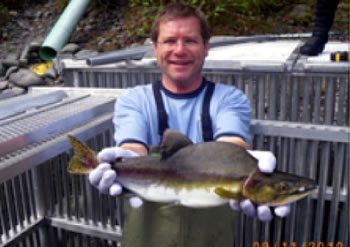
Pink salmon

Sockeye salmon

Bull trout

Cutthroat trout
 
Steelhead