Showing posts with label dam removal. Show all posts

Monday, April 22, 2013

Elwha River Fine Sediment Sampling

Late last summer, the U.S. Fish and Wildlife Service (FWS), NOAA Fisheries, Lower Elwha Klallam Tribe, U.S. Geological Survey, and National Park Service participated in a multi-agency effort to measure fine sediment concentrations in salmon spawning areas of the Elwha River. This sampling was the first to occur following the initiation of dam removal on the Elwha River; baseline data had previously been collected for 2 years prior to dam removal.

Sampling area within the 'shield' showing
sediment conditions prior to dam removal (2010)

The removal of Elwha and Glines Canyon Dams is expected to release 7-8 million cubic meters of sediment. About half of this is fine sediment (silt and clay), which should be transported quickly by the Elwha River into the Strait of Juan de Fuca. However, this material could alter spawning habitat downstream of the dams. Monitoring fine sediments in locations where salmon are likely to spawn will help determine whether any impacts occur and, if so, how long they persist.

We sampled both mainstem and floodplain channel habitat, collecting 30 samples from just below Glines Canyon Dam to near the mouth of the river. A plywood shield blocked water flow during sampling, providing a calm water area where the sample of the river bed material could be collected. We removed the surface layer of the sediment and placed it into a sample bag for later processing to determine sediment size distribution. We also collected a 'before-and-after' water sample to determine the amount of fine sediment that was suspended in the water column during sampling.

Measuring pre-sampling water depths within the shield.
This is done to determine the depth of the sediment sample and
the water volume behind the shield. This volume is used to
calculate the overall weight of fine sediment suspended
in the water column during sampling.
Preliminary results suggest that there is more fine sediment in the spawning areas today than before dam removal began; however, the level was lower than expected. There was also a change from large cobble to gravel substrate in some areas, which will greatly improve salmon spawning habitat. We expect larger changes this year following the complete removal of Glines Canyon Dam, which holds back the majority of the sediment in this river system.


Tuesday, November 15, 2011

Fish on the Move - Tule Fall Chinook in the White Salmon River

Biological Technician Kira Mazzi’s Experiences at Condit Dam

On October 26, 2011, after 100 years in operation, the Condit Dam was blown and decommissioning began. The decision to decommission the dam, owned by PacifiCorp, was due in part to the environmental concern for fish passage. The removal of the dam will open 33 miles of the White Salmon River and its tributaries for steelhead, 21 miles for coho, and 8 miles on the mainstem of the White Salmon River will be opened for tule fall Chinook. As part of PacifiCorp’s environmental obligation, money was set aside for the capture and relocation of tule fall Chinook prior to dam removal.

From August 1, 2011, to October 5, 2011, staff from the U.S. Fish and Wildlife Service (USFWS), Tribal organizations, and other groups worked on the White Salmon River to capture and move as many salmon as possible to sites upstream of the Condit Dam before dam removal. The purpose of this was to ensure that the female salmon wouldn’t lay their eggs in the path of 2.7 million tons of sediment that would be released when the Condit Dam was breached.

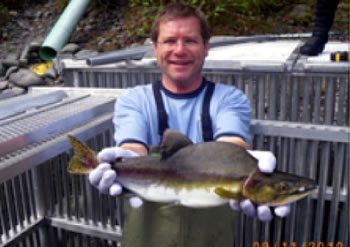
Kira with one of the captured tule fall Chinook
Fish were captured in two ways. Boat seining was used at the mouth of the White Salmon River to trap and corral fish gathering below the first rapids. Once the fish were in the net, biologists removed the fish by hand and placed them into a fish tote located on the boat. Then the fish were transported to a floating barge where biological information was collected--length, sex, and genetics. An identification tag was inserted in each fish to identify them during carcass surveys later in the season. The fish were then loaded into a tanker truck which transported them 3-8 miles upriver to be released at one of three designated locations. The second method of capture was using a weir to direct the Tule into concrete holding ponds. The fish were then crowded and netted out by hand. Electro anesthesia was used to calm the fish while data was collected and an identification tag was inserted. These fish were then transported up river by tanker truck to be released. The combination of these two methods is what allowed for such a successful relocation effort.

In total, 679 fish were caught--380 males and 299 females. This was 179 fish above the goal set by the Chinook relocation project and USFWS. If each captured female lays 4,000 eggs, this project could potentially save more than 1,100,000 baby salmon in this run alone!

For the first time since 1911, the White Salmon River now runs unobstructed, and the fish will now once again live, spawn, and die in their native habitat.

Please check out these videos on YouTube for more information:

Condit Dam and the White Salmon
Condit Dam breach

Thursday, June 30, 2011

Elwha River Bull Trout Rescue

This month, in preparation for removal of the Elwha and Glines Canyon dams, the U.S. Fish and Wildlife Service (FWS), U.S. Geological Survey, NOAA Fisheries, Washington Department of Fish and Wildlife, and the Lower Elwha Tribe participated in a multi-agency effort led by Olympic National Park to capture and relocate Elwha River bull trout from two reservoirs.

Lake Mills (formed by Glines Canyon Dam)
Removal of these large dams on the Elwha River will begin in September 2011 and is the largest dam removal project ever attempted in the United States. Although this historic dam removal will provide fish, including salmon and bull trout, access to 70 miles of pristine habitat upstream of the dams, the removal will also result in short-term water quality levels that are expected to be lethal to fish in the two reservoirs and the section of river downstream of the dams. The cause of the anticipated poor water quality is high turbidity resulting from the release of 17 million cubic yards of silt and gravel currently trapped behind the two dams and sitting at the bottom of the reservoirs where it has collected since the dams were constructed nearly 100 years ago. As a result, the FWS required Olympic National Park to develop and implement a bull trout rescue plan to move bull trout from this area during dam removal.

Helicopter lifting tote containing
40 bull trout destined for the
upper Elwha River
The rescue plan developed by Olympic National Park (and approved by FWS) called for the capture and relocation of up to 100 bull trout from the two reservoirs to locations upstream---Elkhorn and Hayes Rivers. The rescue operation collected 82 bull trout during a 10-day period using hook-and-line sampling and electrofishing techniques. We held the fish in live cages in the upper reservoir until they were flown by helicopter to the two upstream release sites on June 17. We collected a genetics sample and recorded length and weight for each fish in order to monitor how these fish respond to dam removal. We also tagged each fish to determine if the fish remain upstream where they were released or if they migrate back downstream. All 82 fish flown to the upper watershed release sites were alive and doing well at release. Detection of these fish later on will guide fish rescue recommendations for future dam removal projects in other western rivers.

For more information on this project, read the news release from Olympic National Park.


Wednesday, November 10, 2010

Elwha River Weir

An adult fish trap, termed a resistance board weir, was installed in the Elwha River in September 2010 to begin counting adult salmon, trout, and char migrating upstream and downstream in the Elwha River. The weir is part of a multi-agency effort, which includes the Lower Elwha Klallam Tribe, National Oceanic and Atmospheric Administration (NOAA), Olympic National Park, U.S. Fish and Wildlife Service, U.S. Geological Survey, and Washington Department of Fish and Wildlife (WDFW), to monitor the influence of removing two Elwha River hydroelectric dams on salmon and steelhead returns to the Elwha River ecosystem. The goal of the project is to count migrating adult salmon and steelhead to determine if run sizes increase in the Elwha River following dam removal. A portion of the adult salmon captured at the weir will also be used as broodstock for hatchery production and conservation.  Hatcheries will be used for Chinook salmon, coho salmon, chum salmon, pink salmon, and steelhead as a safeguard to protect Elwha River salmon runs during dam removal, which is expected to result in short-term sediment concentrations that may kill adult salmon. In addition, information will be obtained from the weir to determine when different species of adult salmon enter the river, their age, and genetic makeup.

Adult trap (resistance board weir) in the Elwha River
At 195 feet across, the Elwha weir is thought to be the largest floating weir on the WestCcoast. The weir consists of 52 floating panels connected to a substrate rail. The substrate rail is comprised of 10-foot sections of 3-inch angle iron which are bolted together and secured to the streambed using rebar stakes. The floating panels block fish migration and direct the fish to one of four trap boxes; these boxes can be placed in different positions as needed. There are currently three upstream trap boxes---two on one side of the river and one on the opposite bank. There is also one downstream trap box. Now that the substrate rail is in place, the weir can be installed in approximately 2 days and removed in only a few hours.

The new Elwha weir fished for 30 days in 2010 and captured a total of 492 adult salmon and trout, representing eight different species, including Chinook, pink, chum, coho, and sockeye salmon, steelhead, cutthroat trout, and bull trout. Chinook salmon were captured in the greatest number---461 individuals. Pink salmon were the next most common species captured with 12 individuals.  Although the weir was pulled prior to the peak of the coho and chum salmon runs, both species were captured. In addition, summer-run and/or early returning winter-run steelhead were captured.  The capture of pink salmon surprised us, since pinks generally return to Puget Sound rivers only during odd years (2009, 2007, etc.). They have, however, become more common during even years over the last decade.
 
The weir fishing at 2,200 cfs
The weir is planned to fish a majority of the time during the summer and early fall, when Chinook and pink salmon are migrating into the Elwha River. However, it is expected to fish only part-time during late fall through spring when storms and/or snow melt result in high water in the river. The weir fished successfully during flows of 2,200 cubic feet per second (cfs) in late summer (500 cfs is the normal low flow during summer). This was encouraging, since the weir was predicted to be able to fish up to about 2,000 cfs. 

The weir is planned to be re-installed in early 2011 to direct adult steelhead to the river margins where they will be counted using SONAR. The trap boxes will be installed in late winter or early spring to trap adult steelhead. The weir will be removed again during the spring snow melt and then reinstalled with traps as flows begin to decrease in early summer.

This project was funded in part by funds provided to the cooperating agencies as part of their annual budget.  Additional funds were obtained through the President’s stimulus program (American Recovery and Reinvestment Act). The project is currently funded through September 30, 2012.

Here are some of the fish captured by the weir:

Chinook salmon
 
Coho salmon

Chum salmon

Pink salmon

Sockeye salmon

Bull trout

Cutthroat trout
 
Steelhead